Some of the links in this article may be affiliate links. If you make a purchase through these links, we may earn a small commission at no extra cost to you. Thank you.
I’m starting to wonder whether offline GPS apps are really essential for geocaching, or if online maps would do. In my experience, I’ve found Gaia GPS, Locus Map Pro, and C:GEO to be solid offline options that keep caches handy when signals fade. They’re not perfect, but they’re efficient, intuitive, and battery-friendly enough for day trips or longer hunts. If you’ve got a fave, I’m curious how it stacks up.
Thank you for reading this post, don't forget to subscribe!
| NAVA F30 Handheld GPS for Outdoor Adventures |  | Rugged All-Terrain | Type: Handheld GPS | Display: 2.2″ QVGA | Power: Two AA batteries | VIEW LATEST PRICE | Read Our Analysis |
| Rugged Handheld GPS Navigator with Topo Maps |  | Long-Lasting Navigator | Type: Handheld GPS | Display: 3.2″ color | Power: Rechargeable battery | VIEW LATEST PRICE | Read Our Analysis |
| Magellan eXplorist GC Waterproof Geocaching GPS | Geocaching Specialist | Type: Geocaching GPS | Display: 2.2″ color | Power: Two AA batteries | VIEW LATEST PRICE | Read Our Analysis |
More Details on Our Top Picks
NAVA F30 Handheld GPS for Outdoor Adventures
If you’re chasing a rugged, all-in-one unit for offline geocaching, the NAVA F30 might be the pick for you. I’ve found it sturdy enough for outdoor trekking, with GPS, GLONASS, and Beidou keeping fixes pretty reliable. It runs on two AA batteries for up to 20 hours, which feels like a real win on long hunts. Inside, 4 GB memory plus expandable TF card, plus a readable 2.2″ transflective display helps under sun. It ships with a worldwide basemap and supports paperless geocaching, plus free map downloads. I like its simple, practical vibe. It’s not fancy, but it works.
- Type:Handheld GPS
- Display:2.2″ QVGA
- Power:Two AA batteries
- Maps:Worldwide basemap
- GNSS:GPS, GLONASS, Beidou
- Water Resistance:(Not specified)
- Additional Feature:Paperless geocaching
- Additional Feature:NAVA GPS office software
- Additional Feature:Four languages
Rugged Handheld GPS Navigator with Topo Maps
This rugged handheld GPS navigator with topo maps is my pick for geocachers who want offline reliability in harsh conditions. It’s compact and lightweight, with an anti-slip grip that actually feels sturdy in rain or mud. I love the 3.2″ sunlight-readable screen and the physical buttons—they’re just easier than fiddling on a touchscreen when gloves are on. It’s IP66 water resistant, multi-GNSS, and climbs right along with me, GPS, Galileo, Beidou, QZSS. Battery lasts up to 36 hours, which means I don’t have to babysit it. Preloaded USA Topo maps? Yes, plus 32 GB memory. I’m impressed overall today.
- Type:Handheld GPS
- Display:3.2″ color
- Power:Rechargeable battery
- Maps:Preloaded USA Topo maps
- GNSS:GPS, GALILEO, BEIDOU, QZSS
- Water Resistance:IP66
- Additional Feature:3-axis compass
- Additional Feature:Barometric altimeter
- Additional Feature:USB-C charging
Magellan eXplorist GC Waterproof Geocaching GPS
A device that’s built specifically for geocaching really stands out, and the Magellan eXplorist GC Waterproof Geocaching GPS is exactly that. I like its rugged, IPX-7 build and the fact that it’s 100% geocaching-dedicated. It’s a paperless dream with instant geocaching.com connection, and the 2.2-inch color screen stays readable in sun, which is huge in my book. It runs on two AA batteries for up to 18 hours, which means fewer pit stops. It’s fast to navigate, with intuitive menus, and I feel like it’s my trusted hiking buddy—reliable, simple, and surprisingly capable. I’d actually recommend it for beginners,
- Type:Geocaching GPS
- Display:2.2″ color
- Power:Two AA batteries
- Maps:Worldwide basemap
- GNSS:SiRFstarIII GPS
- Water Resistance:IPX-7
- Additional Feature:Geocaching.com integration
- Additional Feature:Cache capacity 10,000
- Additional Feature:VantagePoint compatibility
Factors to Consider When Choosing Offline GPS Apps for Geocaching
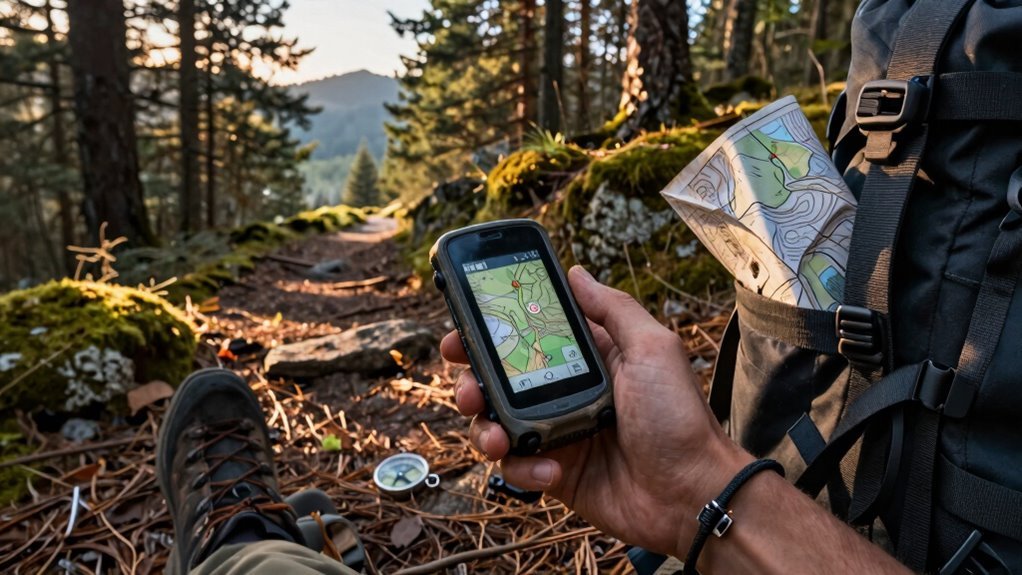
When I pick an offline GPS app for geocaching, I look at map coverage offline and how well it caches areas. I also care about battery life, data format support, and whether it runs on my device without hiccups, because dead batteries ruin hunts. In my experience, being able to access caches offline is the real test, since connectivity isn’t always there, and that kind of reliability matters more than flashy features.
Map Coverage Offline
If you’re planning geocaching offline, you’ll want to understand map coverage because it directly affects how far you can go without internet. Offline map coverage determines how large an area you can navigate, whether the app gives worldwide basemaps or regional options. I’ve found that vector maps offer scalable detail and smaller file sizes than raster maps, which matters when you’re juggling storage. Preloaded basemaps or downloadable map packs spell out what regions stay offline, but they may need frequent updates for accuracy. The map formats supported offline—vector vs raster and file types—affect compatibility and how much you’ll stash on your device. Memory limits decide how many offline tiles or regions you can actually keep handy. In short, plan ahead and test areas offline.
Battery Life
Battery life isn’t just a number on the box; after you’ve pinned down offline map coverage, you still have to stay powered through the hunt. In practice, battery choice can stretch a geocache run quite a bit. Some handheld units run 20 hours on two AA cells, which is enough for a long day, but you’ll want backups. Others boast up to 36 hours on a full recharge, and that longer endurance really matters when you’re chasing multi-day cache lines. For rechargeable systems, USB-C or similar charging can tip the scales toward continuous use. If it’s multi-day, I’d prioritize the longest runtime to minimize that dreaded shutdown during caches. I’m not sure every model delivers, but I count endurance as a top feature today.
Data Format Support
Data format support matters more than you might think when you’re geocaching offline. I look for apps that handle GPX, KML, CSV, SHP, MIF, DXF, and TX so I can swap data with other tools without headaches. It’s not just reading formats, but importing and exporting waypoints, tracks, and routes across several types for flexible data exchange. I want NMEA output too, so I can share raw GPS data with devices I trust. A worldwide basemap that can be converted between formats without losing details feels like a safety net. I also check for PC or offline software options that link to these data formats, helping me manage caches outside the device. That flexibility saves time and keeps maps usable anywhere, in tricky spots.
Device Compatibility
Device compatibility isn’t just a checkbox for me—it shapes everything from setup to field performance. When I pick an offline geocaching app, I start with the OS it runs on—Android, iOS, or Windows—as a non-negotiable. If the device can’t support the app, the rest is just wasted effort. Then I check GNSS support—GPS, GLONASS, BEIDOU, GALILEO, you name it—because reliable satellite positioning saves frustration in remote spots. Storage matters too; I want expandable memory so offline maps and caches fit without breaking the bank. Power matters as well—AA vs. rechargeable, I’m thinking about long days out. Finally, durability isn’t optional; water resistance, rugged build, and sunlight-readable screens matter when rain or glare hit. I’m careful to balance features with real-world needs, though, today anyway.
Cache Access Offline
How much offline cache you can access is really the core of choosing the right app, isn’t it? I’ve found that paperless caching models keep a local database, so you can view details, hints, and logs without a connection. But storing thousands of caches demands solid onboard memory or expandable storage. Some devices let you sync online data, yet you can still navigate cached caches offline. Map availability and the device’s ability to show attributes, logs, spoilers, and photos can limit offline use. In my experience, bigger caches are like libraries—you’ll need space and a smart method to organize them. If you’re unsure, aim for scalable options and check how data transfers when you’re online. I’m not sure, but offline access matters a lot.
UI Simplicity
Isn’t it nice when a geocaching app feels almost telepathic the moment you open it? I look for UI simplicity like gold—intuitive menus and simple controls that cut the learning curve during a hunt. A dedicated geocaching interface with minimal steps for sending caches and viewing details, that’s what keeps navigation smooth, you know? I also want a clear, sunlight-readable display—transflective or color LCD—that reduces clutter outdoors. In rugged conditions, physical buttons beat touchscreens, hands down. And easy offline data management matters: GPX, KML, CSV, DXF support for quick imports and quick access to caches and waypoints. In my experience, simple is powerful—less fluff, more finding. If it feels clunky, I’ll probably drift away to a map app that respects pace and silence outside.
Conclusion
Geocaching isn’t just about maps; it’s about what you discover hidden in silence between trails. I’ve tested Gaia GPS, Locus Map Pro, and C:GEO, and I’ll tell you this: they’re all capable, but your choice shapes the hunt. I’m not saying one is perfect, maybe not, but the right app feels almost like a trusted compass. Pick yours, charge up, and trust the unknown—the next waypoint might change everything. Just wait, your next waypoint surprises.